'Tis the season for graduations and my 2026 "20 lessons" list
'Tis the season for graduations, new jobs and life transitions. It's also the season for my annual updated "20 lessons" list. (It's also when I like to dust off this old photo below of me sitting at my first desk at my first job on Capitol Hill).

A number of years ago, I started a list of professional life lessons for a presentation to a group of college seniors. Since then, I like to revisit and update this list annually as a way to reflect on the past year.
My #1 lesson this year comes from being more deliberate and focused in my communications coaching work by starting every session with the disclaimer of "I don't have all the answers." I’ll admit, it took a little courage to drop this disclaimer into my slide deck. I sure didn’t want to come across as unsure or wishy-washy about what I teach.
But sharing those six words seemed to encourage questions, calm nerves and give people space to think about themselves a little differently. I approached my work with a "let's figure this out together" perspective instead of a "I have all the answers" perspective.
That’s a great lesson for me to remember for life in general and the perfect addition to top this year’s list.
Accepting it's OK not to have all the answers opens me up to work from a place of curiosity, patience and genuine inquiry recognizing everyone’s strengths are their own, and everyone’s challenges will vary.
Writing and speaking are such subjective topics. I like to acknowledge that age, education level, geography and culture all impact how we speak and write. I try to ask questions and encourage people to challenge what I’m teaching. In the process, I’ve learned far more than I would have just putting “rules” of speaking or writing out there.
I suppose this realization that it's OK not to have all the answers is part of the gift bestowed by years of experience. It's a lesson I wish I'd someone had offered me this grace when I was sitting at that first desk on Capitol Hill as a newly minted professional thinking I was expected to have all the answers. I had no idea of the lessons I’d learn along the way. Here's this year's version of some of those lessons.
Lessons from diploma to today
Hopefully seasoned and new professionals alike will find a nugget or two here.
1. It's OK not to have all the answers. This is a lesson I've learned only recently from my work coaching people to be better speakers and writers. I always preface this work with the disclaimer that "I don't have all the answers." While this approach may sound counterintuitive, my goal is to recognize we’re all different. That means I can’t always respond to a question with the same answer for everyone. Taking this approach forces me to listen better to make sure I'm giving the response most helpful to the person asking the question. It's a valuable lesson for all parts of my life.
2. Cultivate strong writing skills even if writing isn’t a priority part of your job. Solid writers are the people strong leaders want around the leadership table with them. Be the one colleagues seek out to flesh out and articulate ideas clearly on paper with accurate spelling, grammar and punctuation. Even if writing isn't a priority part of your job, be the one on the team who can quickly break down and communicate concepts on paper with clarity and purpose (and remember, avoid fluffy words that are the drunk party crashers of writing).
3. Write thank-you and follow-up notes (handwritten, not emailed). Collect business cards or contact info from people you meet at events, in meetings, or just out and about. A handwritten "nice to meet you" note will set you apart and help people you meet remember you. Technology is good, but the personal touch still matters (along with good penmanship).
4. Sharpen your speaking skills. A strong speaking presence doesn’t come naturally to everyone, but practice can help anyone improve. Seek out opportunities to speak up in meetings, identify your pain points, practice in front of a mirror, watch speakers you admire. Learn to be the one in the room who can catch - and keep - people’s attention.
5. Seek out a mentor. I’ve found most mentor relationships happen naturally rather than being established formally. Be on the lookout for them. I bet my best mentors probably don't know they even encouraged me in that role. Also, look for "reverse mentoring" opportunities. Young professionals can be a resource to your older colleagues. Seasoned professionals can learn a great deal from their younger peers.
6. Take risks. Look for the unexpected opportunities. No one can expect perfection. It’s OK to be a beginner. You can often learn more from mistakes than successes. Yes, really, you can.
7. Be kind and remember that everyone carries their own sack of rocks. You never know what type of personal issues the co-worker who missed a deadline is dealing with at home or with his family.
8. Keep up with people. The students you sat next to in class. Your roommates and their friends. Bosses in your entry level college jobs. Lab partners. Professors. They will all have contacts within their professional circles. Stay in touch with them. You never know where a new job contact, sales relationship or your next stellar employee will come from. Every job change I ever made was the result of someone I knew making a connection for me. Every one of my current Medway Group clients grew out of established relationships.
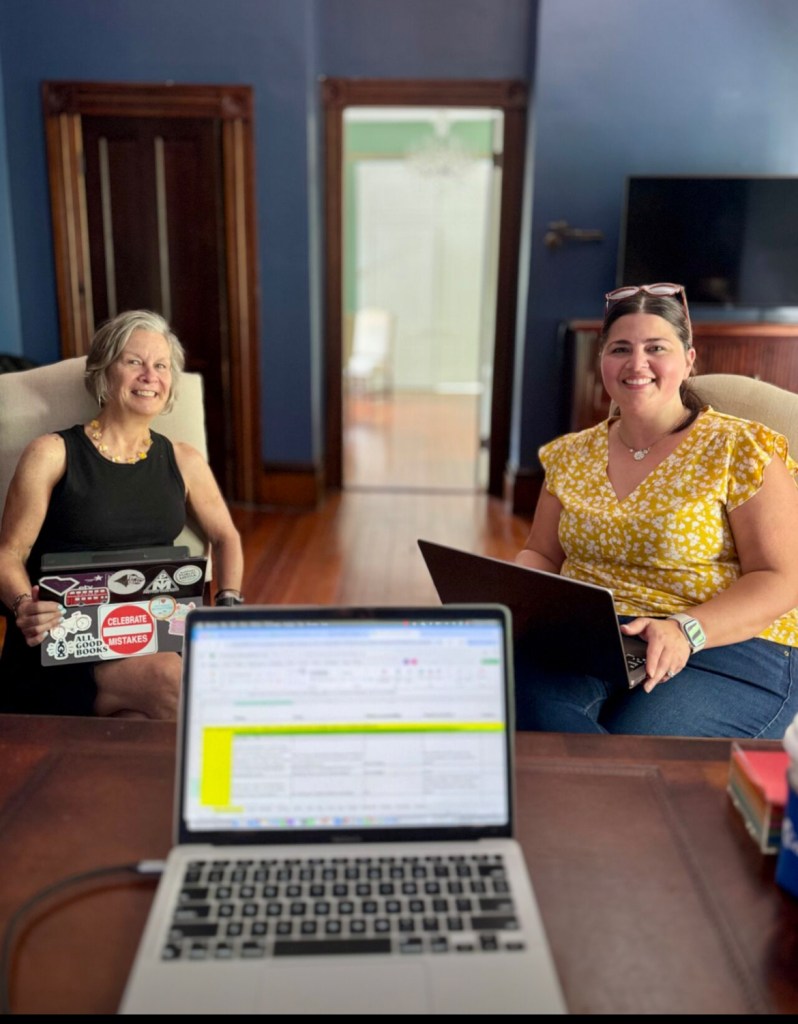
The photo below is with Danielle Salley of Danielle Salley Creative who I've known for many years because she was my husband's co-worker. I contracted with her company last year to update my Medway Group website. We have cross-pollinated on a couple of clients, and I'm grateful for that relationship.
9. Travel any chance you get. Travel to small towns and big cities across the country and around the world. Don't put off travel - USE YOUR VACATION. You'll never tell your grandchildren about that great trip you didn't take because you were too busy at work. Be present in your travel and leave your work behind.
10. Plan the work before you work the plan (this one is a nod to my dad's saying). Having no plan gets you nowhere. Plans will change either by force or circumstance. Be flexible, but have a plan regardless of whether it's a work project, a trip, a job search, a major purchase or an important life decision.
11. Looking busy doesn't equal being productive. The co-worker who crows about her heavy workload and long hours is probably much less productive than the one who is organized and prioritizes his days.
12. Go to your boss with a solution, not a problem. Your boss is solving problems all day. Make her life easier by presenting a solution when you present a problem. Even if it's not the solution that ultimately solves the problem, presenting an idea for a solution keeps your boss from dreading the sight of you at the door or your number on her phone.
13. Stay in the loop, but avoid the gossip. Be a "boundary spanner"— someone who is respected and trusted by people at all levels of the organization. Just don’t be the one who everyone counts on to know “the dirt.”
14. Build your financial literacy. Pay yourself first. Set up an allocated amount to go directly to your savings account from each paycheck. If you get the chance to participate in your company’s 401K, do it! Even that smallest contribution early in your career will help you establish good saving and investment habits. Learn the basics of budgeting, saving and investing. Keep your rainy day fund separate from your retirement dollars.
Back when I was just starting out as an adult, my future husband learned I had $800 in store credit card debt. He encouraged me to get a loan from the credit union and pay off the card. For the next 16 months, I had $25 deducted from my paycheck to pay off the loan. Once it was paid off, I just kept paying myself that $25. Over the years, that account built up. I've reroofed the house, paid cash for a new car, replaced two HVAC units and funded multiple big trips thanks to that initially small savings account that's just grown over the years.
15. Be interested and interesting. Ask good questions and ask them often. Young professionals have a great deal to offer a work environment. Speak up when you have something to offer, but remember to balance your enthusiasm with senior-level colleagues' experience.
16. A good editor will make you shine. Don't look at having your writing edited as you would look at a teacher correcting a paper. Editing is a collaborative process, and there's always room for improvement in your writing.
Over the years, I've learned that editing with a purple pen is less intimating to people than using the dreaded red pen of our high school English teachers. Give it a try!
17. Move during the day. Regardless of whether you have a desk job, use your lap as your desk while sitting on the couch or work outside of a traditional office environment, moving your body and getting your brain engaged in something other than your work is key to sanity and creativity. Walk around the block, stretch once an hour, or put in your earbuds and listen to high energy music.
18. Keep learning your craft. Find out what your boss or leaders in your profession are reading or listening to (books, blogs, professional publications, podcasts, websites, etc). Seek out professional development opportunities. Pay for them yourself, if necessary. Join professional organizations and get involved.
19. Establish your personal brand. Decide what you want your reputation in the workplace to be, and let your actions define you. Keep promises and make deadlines. Under-promise and over-deliver. Avoid behavior in your personal life that could hurt your professional life (even more true today with all the risks of social media in the mix). Remember that details count, especially when getting the details right sets you apart from others.
20. Have fun and be creative. Figure out your own version of work/life balance. The "balance" will probably fluctuate daily, and it most certainly looks different after surviving the COVID years, but keep focused on creative outlets, exercise and hobbies that let you have fun.
Photo below is from a gig with our band, Flossie Dog, at Steel Hands in Columbia. We will probably never be good enough to quit life and join the band, but we sure have fun!

Following my own advice
Over the past several years, I’ve realized it’s never too late to follow my own advice while growing as a business owner at The Medway Group.
I’ve connected my love of writing (#2) and editing (#16) with the relationships I’ve developed over my career (#8). I’ve spent a lot of time evaluating my strengths, identifying opportunities, learning all I could about being an entrepreneur (#18), getting comfortable with not having all the answers (#1), and plotting a plan (#10).
Thanks to insight and advice from many professional colleagues and mentors (#5 and 18), I’m now busy helping clients with their writing and editing projects. I’m working with organizations to fine tune their communications planning and staffing. I’m actually being paid to share my love of being a policy nerd. I'm also leading media training, business etiquette and writing through my work with the Buckley School of Public Speaking.
I’m grateful for the opportunities today that let me share my strengths and do the type of work I enjoy. (Read more about the work The Medway Group is up to these days.) I’m also making sure not to overlook the importance of that balance we hear so much about (#20) by making time for my music, family, friends, and travel (#9).
And I keep sending those hand-written thank you notes (#3).


Comments
Post a Comment
I love hearing from readers. Let me know what you think! Please sign your name if you're not already signed into Blogger so I can see who is posting (otherwise it shows up as anonymous).